The book assumes last year
A derivation skips three steps because "the reader will recall". You do not recall, and the page stops making sense.
Upload the book your course is built on. Get each chapter as a lecture that explains every formula where it appears, draws what the author only describes, and can be listened to on the way to class.
Trascini qui il suo libro
EPUB, FB2, PDF, DjVu o TXT, fino a 200 MB
Il suo file resta privato
A derivation skips three steps because "the reader will recall". You do not recall, and the page stops making sense.
Dense text with no picture. You follow each sentence and still cannot say what the paragraph was about.
A video on the topic is easier, but the lecturer asks for this book’s notation, this book’s order, this book’s results.
Five levels, from the text as written to the big picture. "Formulas explained" keeps every formula of the book and says what it states, where it comes from, and runs one calculation aloud.
Each lecture is cut into scenes with a diagram that builds as the voice speaks. Every drawing is looked at before you see it; a wrong one is redrawn.
The lectures follow the book’s order, terms and results. Each part is compared with its passage by a second model, and what differs is corrected.
Say what you already know or do, in a sentence, and the examples are built on that instead of on someone else’s hobby.
Voce, disegni e testo in qualsiasi combinazione. Può cambiare quando vuole.
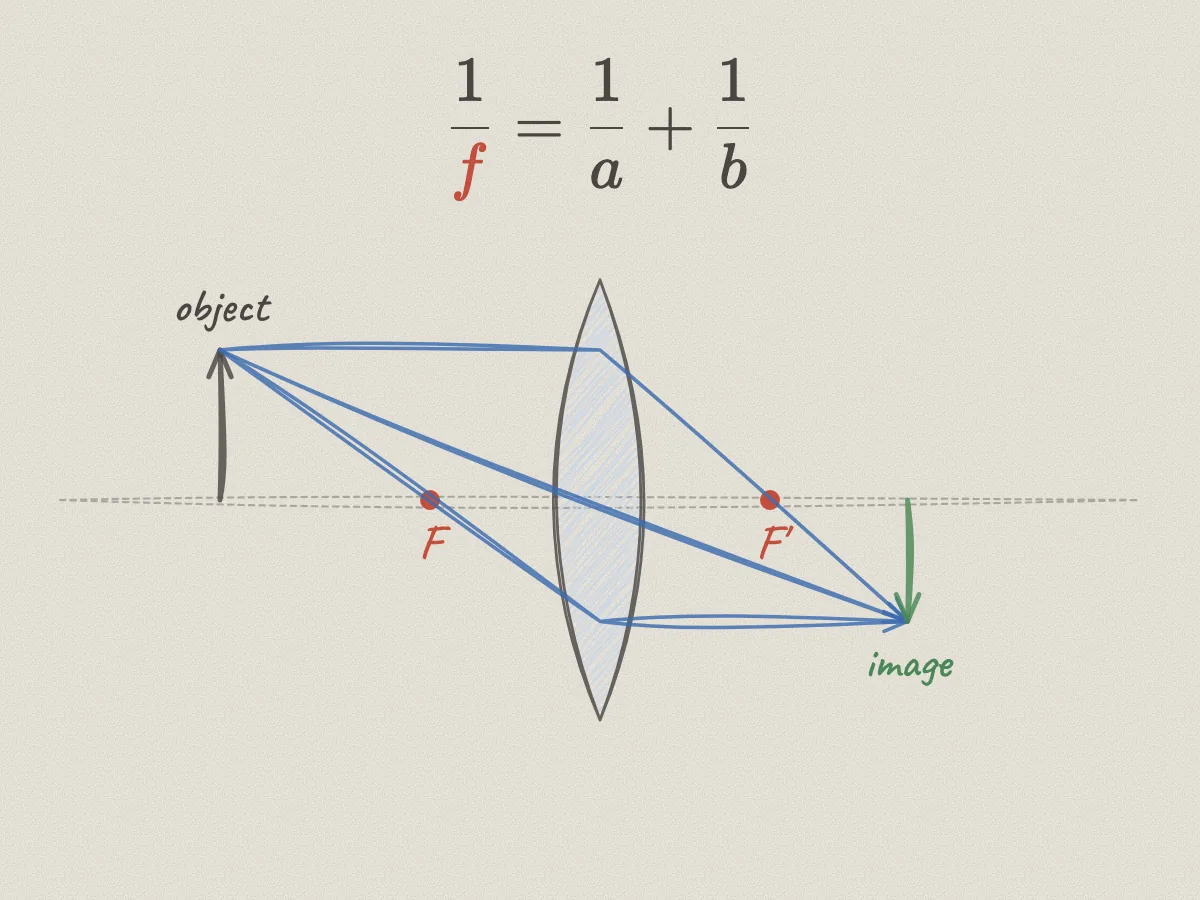
The first thing to know about a lens is how hard it bends light. Hold a magnifying glass in the sun: the rays arrive side by side, leave it leaning towards one another, and a little way behind the glass they meet in a bright dot. The distance from the glass to that dot is the focal length, and nearly everything else about the lens follows from it.
A lens is stronger when its glass is denser and its surfaces are more curved. Take ordinary glass, in which light travels one and a half times slower than in air, and curve both sides like a ball twenty centimetres across. Work it through and the focal length comes out at about ten centimetres: sunlight gathers into a point a palm's width behind the lens.
The book writes this as a formula, and we will come to it in a moment. It says no more than what we have just seen: denser glass or more curved surfaces, and the focal length gets shorter.
The distance from the glass to that dot is the focal length, and nearly everything else about the lens follows from it.
A lens is stronger when its glass is denser and its surfaces are more curved.
EPUB, FB2, PDF, DjVu or plain text, scans included. Choose the pages or chapters the next seminar covers.
For a course with an exam, keep the formulas. Switch to "Ideas and examples" for a first pass through a hard topic.
After the lecture the book’s own page reads differently: you know where it is going.
The first ten pages are free: enough to know whether it explains the book the way you need.
Upload the textbookNo, and it does not try to. It gets you through the chapter the first time, with the book’s own notation and results, so that the textbook becomes readable. For an exam, go back to the book afterwards.
It is written by AI, so yes. Each part is checked against the book and corrected, and each drawing is looked at before it is shown, but check what matters for your exam against the book itself.
The beginning of the course, about ten pages of the book, is free. After that the price depends on how much text you choose, and you see it before anything is made. Start with the chapters you need.
The reference book of your field, at the depth today’s task needs.
See howRead into the neighbouring field without losing a month to its textbook.
See howSee a hard chapter explained five ways before you explain it yourself.
See howThe great hard books you always meant to read, finally followed to the end.
See how