No time to read it properly
You need three chapters out of twenty, and the three depend on notation defined in the other seventeen.
Upload the monograph, the manual or the standard everyone cites. Get the chapters you need as lectures at the depth you choose, with the examples taken from your own work.
Trascini qui il suo libro
EPUB, FB2, PDF, DjVu o TXT, fino a 200 MB
Il suo file resta privato
You need three chapters out of twenty, and the three depend on notation defined in the other seventeen.
The classic of the field uses terms, units and examples nobody on your team has met.
A page of bullet points tells you what the book concludes, not why, and you have to defend the why in a review.
An hour-long overview of the whole book to find what matters, then the chapters that matter with every formula kept and explained.
Tell it what you build or measure. A lens formula is then explained on your camera, a control loop on your machine.
The whole text is read before the first lecture is written, so a thing keeps one name through the course, and each part knows what the earlier ones explained.
For a PDF or a scan, the pages with figures, tables and formulas are looked at as images, so what the text extraction lost still reaches the lecture.
Voce, disegni e testo in qualsiasi combinazione. Può cambiare quando vuole.
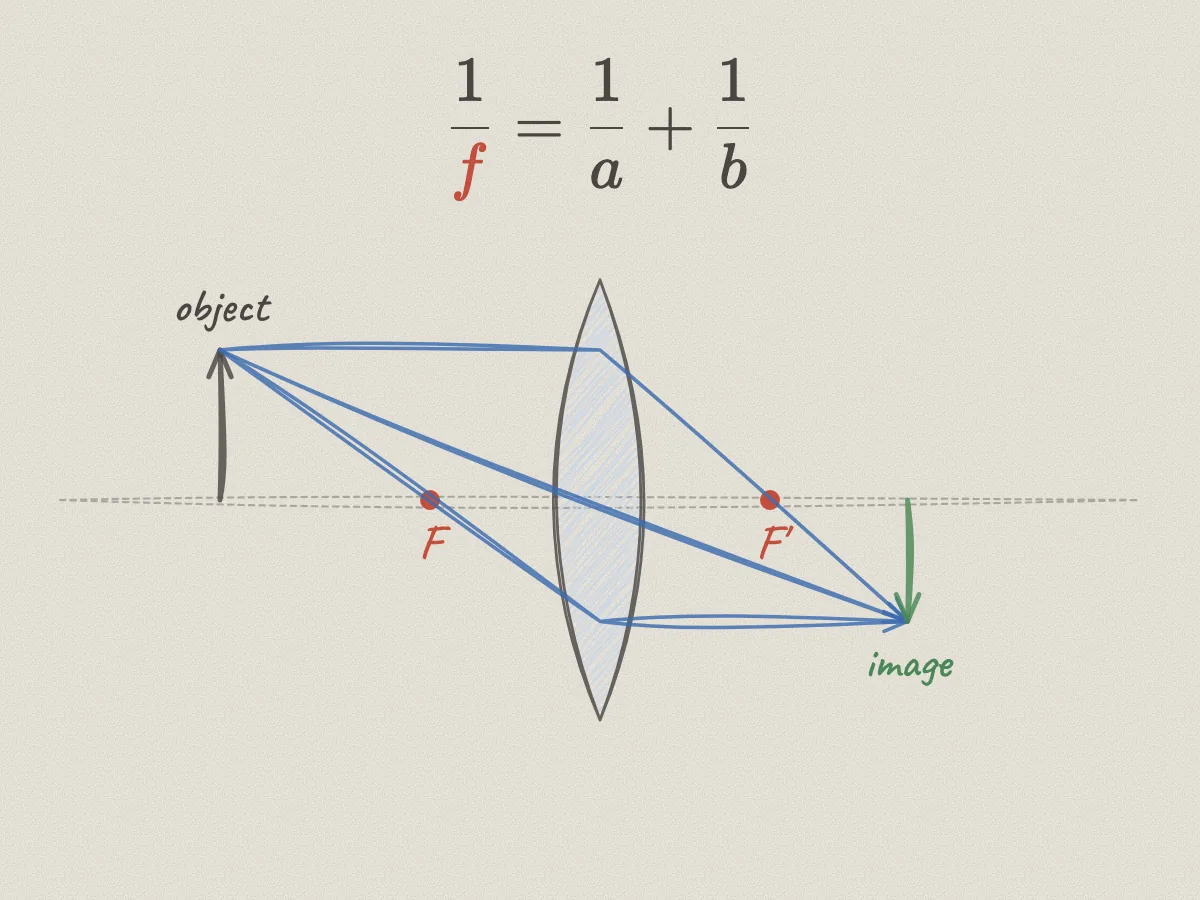
The first thing to know about a lens is how hard it bends light. Hold a magnifying glass in the sun: the rays arrive side by side, leave it leaning towards one another, and a little way behind the glass they meet in a bright dot. The distance from the glass to that dot is the focal length, and nearly everything else about the lens follows from it.
A lens is stronger when its glass is denser and its surfaces are more curved. Take ordinary glass, in which light travels one and a half times slower than in air, and curve both sides like a ball twenty centimetres across. Work it through and the focal length comes out at about ten centimetres: sunlight gathers into a point a palm's width behind the lens.
The book writes this as a formula, and we will come to it in a moment. It says no more than what we have just seen: denser glass or more curved surfaces, and the focal length gets shorter.
The distance from the glass to that dot is the focal length, and nearly everything else about the lens follows from it.
A lens is stronger when its glass is denser and its surfaces are more curved.
The whole book in about an hour. Enough to decide which chapters deserve the full treatment.
Choose the chapters and "Formulas explained" or "Formulas in words". You see the price before anything is made.
One sentence about your field in "Your own examples" changes every example in the course.
Upload it and listen to the free sample before paying for anything.
Upload the bookUse it to understand the book, and take the numbers you will rely on from the book itself. The lectures are AI-generated; each part is checked against its passage and corrected, which lowers the error rate and does not make it zero.
Scanned PDF and DjVu files are recognised, and pages with figures and formulas are also read as images. Very poor scans come out worse; the free sample shows what your file gives.
Yes. With a studio voice a course can be downloaded as MP3, and as MP4 with the drawings.
The textbook the course is built on, at a level you can follow tonight.
See howRead into the neighbouring field without losing a month to its textbook.
See howSee a hard chapter explained five ways before you explain it yourself.
See howThe great hard books you always meant to read, finally followed to the end.
See how