Another field’s notation
The same symbol means something else two departments away, and the book defines it on page 12 of a chapter you skipped.
Upload the standard text of the neighbouring field. Get it retold with the mathematics kept and the notation explained, by a lecturer who knows what you already know.
Upuść tutaj książkę
EPUB, FB2, PDF, DjVu lub TXT, do 200 MB
Twój plik pozostaje prywatny
The same symbol means something else two departments away, and the book defines it on page 12 of a chapter you skipped.
Popular accounts drop the mathematics you need; the papers assume all of it.
Working through a graduate textbook properly costs weeks before the first useful idea.
At "Formulas explained" every formula and derivation of the passage is kept, shown as printed, and explained: what it says, where it comes from, one calculation with numbers.
Say which field you come from. A statistician reading thermodynamics gets entropy by way of likelihood, not by way of steam engines.
A map of the whole text is made first: what it argues, which terms recur. Each lecture is written with that map and with the terms the earlier ones introduced.
Every part is compared with its passage by a second model. Sentences that contradict the book, or state what it does not, are rewritten.
Głos, rysunki i tekst w dowolnym połączeniu. Przełączaj je, kiedy chcesz.
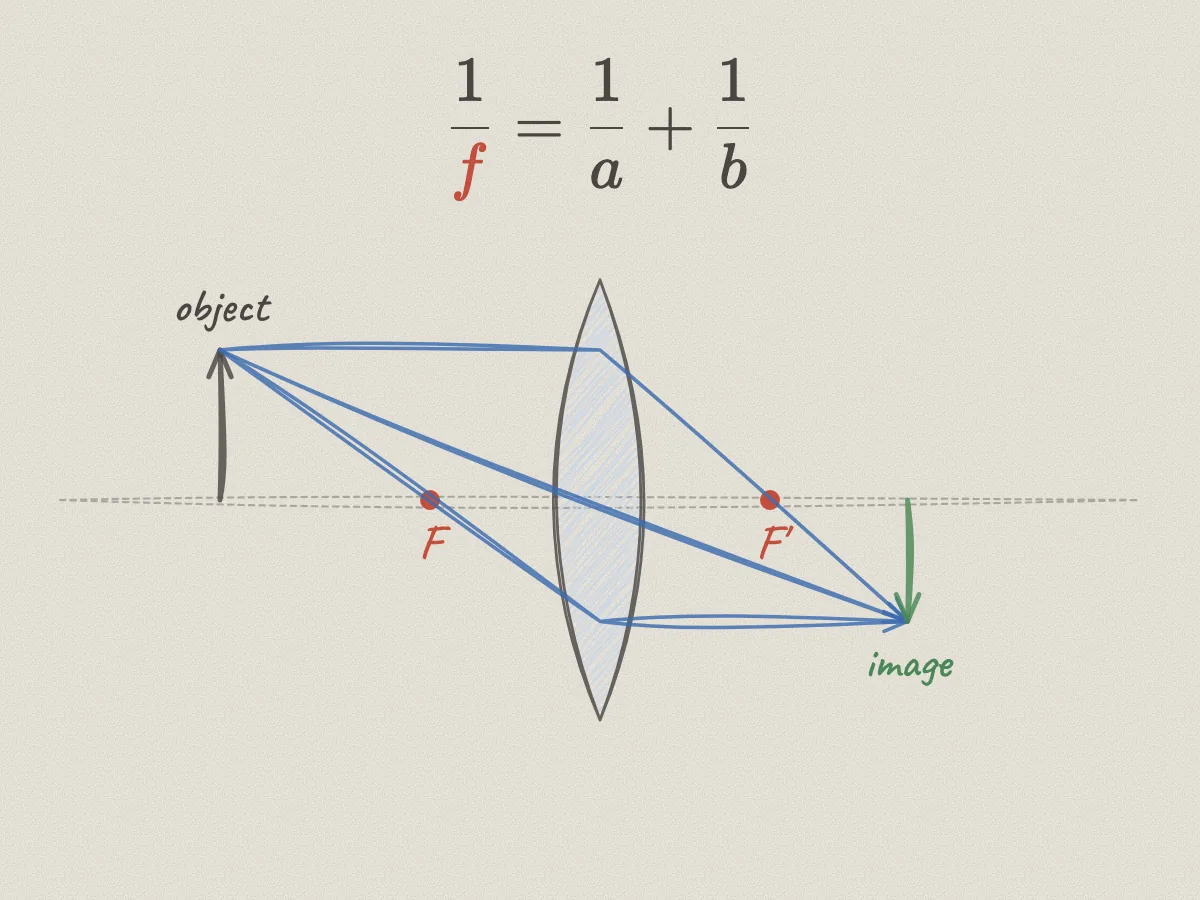
The first thing to know about a lens is how hard it bends light. Hold a magnifying glass in the sun: the rays arrive side by side, leave it leaning towards one another, and a little way behind the glass they meet in a bright dot. The distance from the glass to that dot is the focal length, and nearly everything else about the lens follows from it.
A lens is stronger when its glass is denser and its surfaces are more curved. Take ordinary glass, in which light travels one and a half times slower than in air, and curve both sides like a ball twenty centimetres across. Work it through and the focal length comes out at about ten centimetres: sunlight gathers into a point a palm's width behind the lens.
The book writes this as a formula, and we will come to it in a moment. It says no more than what we have just seen: denser glass or more curved surfaces, and the focal length gets shorter.
The distance from the glass to that dot is the focal length, and nearly everything else about the lens follows from it.
A lens is stronger when its glass is denser and its surfaces are more curved.
"Big picture" gives the argument of the book in about an hour and shows which chapters carry it.
Choose them by chapter or page range, with "Formulas explained".
Put it in "Your own examples": the analogies will start from there.
Cite the book. The lectures are an AI-generated retelling made to get you through it; they follow its order and results so that you can find the page.
Each part is checked against its passage and corrected, and the report of that check is kept with the part. It is still AI-generated: verify what your work will rest on.
A book in one language can be told in another: the lectures are a retelling in the language you choose, with terms in the form usual in that language.
The textbook the course is built on, at a level you can follow tonight.
See howThe reference book of your field, at the depth today’s task needs.
See howSee a hard chapter explained five ways before you explain it yourself.
See howThe great hard books you always meant to read, finally followed to the end.
See how