It was written for specialists
The author assumes a degree you do not have, and the first chapter makes that clear.
Upload the great hard book you always meant to read. Listen to it as lectures that explain instead of assuming, at a walk, in the car or with the drawings in front of you.
Перетягніть книгу сюди
EPUB, FB2, PDF, DjVu або TXT, до 200 МБ
Ваш файл залишається приватним
The author assumes a degree you do not have, and the first chapter makes that clear.
Ten minutes of key takeaways, and a week later you remember that the book exists.
The hours you have are on the road, at the gym, with your hands busy.
At "Ideas and examples" every idea is explained through something everyday, and a term appears only if you will meet it again.
A storyteller who gives you the people and the discoveries, or a playful physicist with thought experiments: eight manners.
Say you are a photographer, a cook or a sailor, and the examples come from there.
The lectures follow the book chapter by chapter. Or take "Big picture" first: the whole book in about an hour.
Голос, малюнки й текст у будь-якому поєднанні. Перемикайтеся коли завгодно.
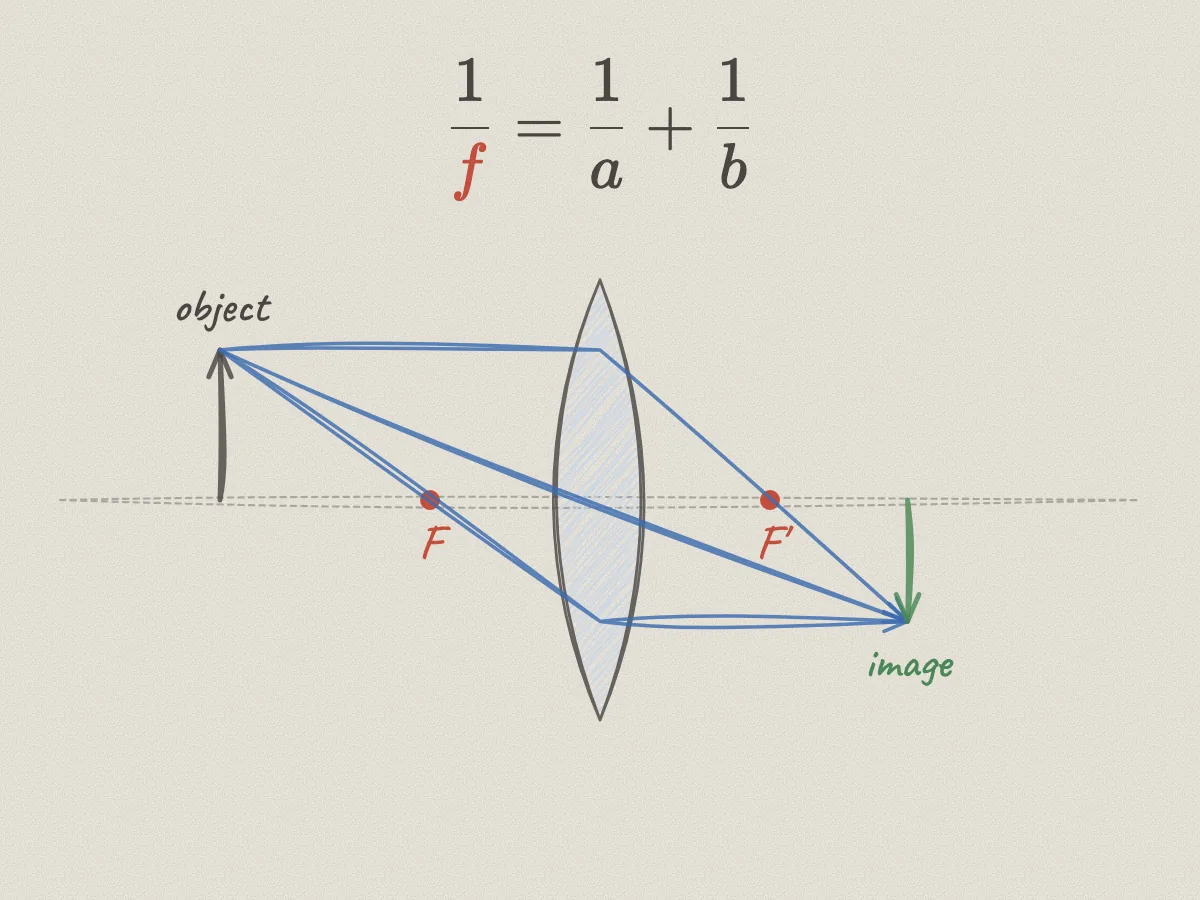
The first thing to know about a lens is how hard it bends light. Hold a magnifying glass in the sun: the rays arrive side by side, leave it leaning towards one another, and a little way behind the glass they meet in a bright dot. The distance from the glass to that dot is the focal length, and nearly everything else about the lens follows from it.
A lens is stronger when its glass is denser and its surfaces are more curved. Take ordinary glass, in which light travels one and a half times slower than in air, and curve both sides like a ball twenty centimetres across. Work it through and the focal length comes out at about ten centimetres: sunlight gathers into a point a palm's width behind the lens.
The book writes this as a formula, and we will come to it in a moment. It says no more than what we have just seen: denser glass or more curved surfaces, and the focal length gets shorter.
The distance from the glass to that dot is the focal length, and nearly everything else about the lens follows from it.
A lens is stronger when its glass is denser and its surfaces are more curved.
Any of the usual formats, scans too. Public-domain classics are easy to find.
And a manner you would enjoy for ten hours: the sample lets you hear it first.
On your phone, in the browser, with your device’s own voice for free or a studio voice.
No. A summary shortens; this explains. At most levels the lectures are about as long as the book, because the missing steps and examples are put back in. Only "Big picture" is short on purpose.
Choose a level without formulas and say in a sentence what you do know. The lecturer starts from there.
The first ten pages are free. After that the price depends on the length you choose, and you see it before anything is made. Listening with your device’s voice adds nothing.
The textbook the course is built on, at a level you can follow tonight.
See howThe reference book of your field, at the depth today’s task needs.
See howRead into the neighbouring field without losing a month to its textbook.
See howSee a hard chapter explained five ways before you explain it yourself.
See how