One explanation for thirty people
The level that suits the middle of the class loses the front row and the back row at once.
Upload the chapter you teach. Hear it explained at five levels, with a drawing for each idea, and use it as raw material for your own lecture or as help for a student who fell behind.
Drop your book here
EPUB, FB2, PDF, DjVu or TXT, up to 200 MB
Your file stays private
The level that suits the middle of the class loses the front row and the back row at once.
Finding the example, the drawing and the order that work for this chapter is the slow part.
They need the chapter told again from the beginning, and you have no free hour to do it.
From the text as written to the big picture. Compare them side by side and choose where your class should start.
Each idea gets a diagram that appears step by step as it is explained, in one of six drawing styles.
A patient tutor, a questioner, a demonstrator who starts from an experiment: the manner of the lecturer is a setting.
With a studio voice a course downloads as MP3, or as MP4 with the drawings, for the student who needs it again.
Voice, drawings and text in any combination. Switch whenever you like.
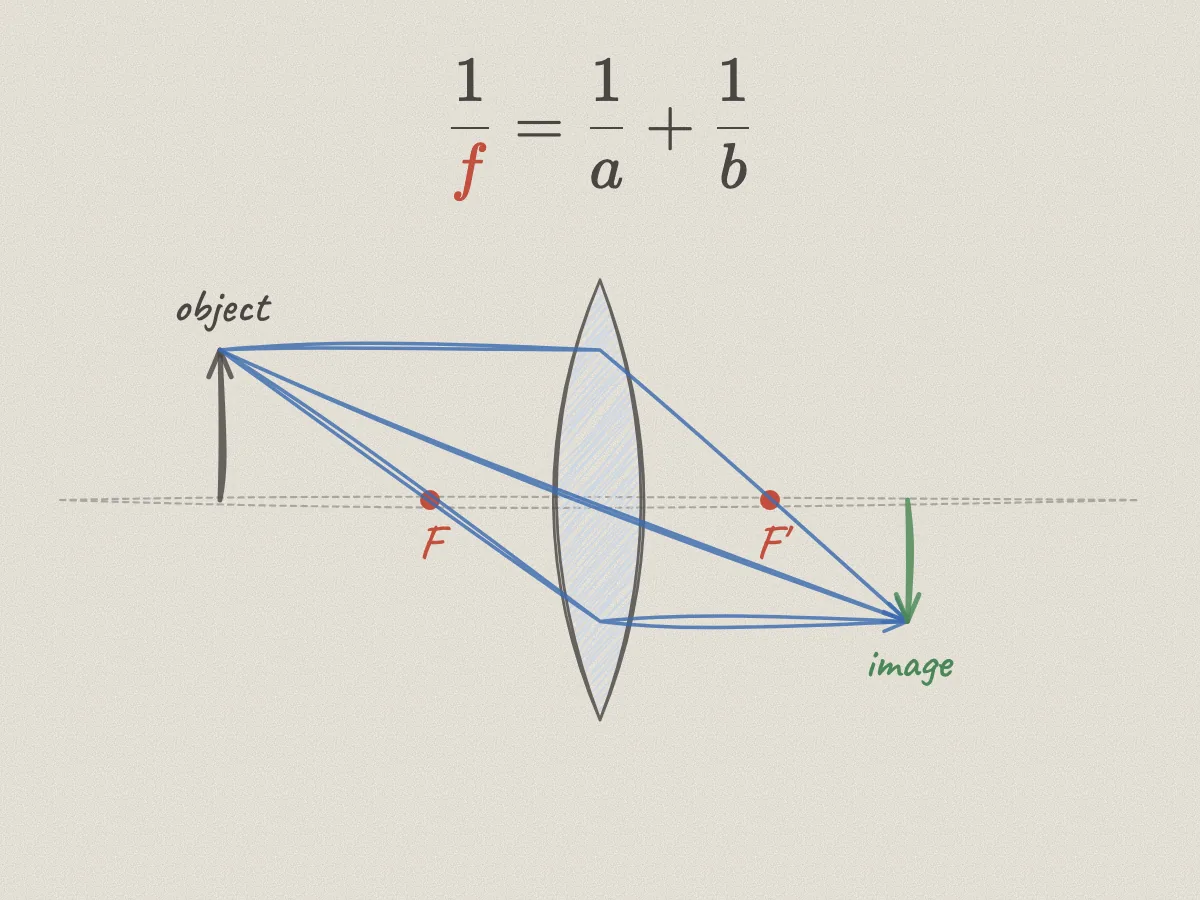
The first thing to know about a lens is how hard it bends light. Hold a magnifying glass in the sun: the rays arrive side by side, leave it leaning towards one another, and a little way behind the glass they meet in a bright dot. The distance from the glass to that dot is the focal length, and nearly everything else about the lens follows from it.
A lens is stronger when its glass is denser and its surfaces are more curved. Take ordinary glass, in which light travels one and a half times slower than in air, and curve both sides like a ball twenty centimetres across. Work it through and the focal length comes out at about ten centimetres: sunlight gathers into a point a palm's width behind the lens.
The book writes this as a formula, and we will come to it in a moment. It says no more than what we have just seen: denser glass or more curved surfaces, and the focal length gets shorter.
The distance from the glass to that dot is the focal length, and nearly everything else about the lens follows from it.
A lens is stronger when its glass is denser and its surfaces are more curved.
Choose the pages you teach next week.
The free sample takes minutes; change the level and make it again to hear the difference.
In "Your own examples", say who the students are and what they care about.
What you make from a book is for your own use of that book; the book’s copyright stays with its owner. Upload only texts you have the right to use this way, and tell students the lectures are AI-generated.
Treat it as a well-prepared assistant’s draft. Each part is checked against the book and each drawing is looked at before it is shown, but you are the one who knows the subject: review it before it reaches a class.
Yes: each of them can upload the chapter and choose their own level and their own examples.
The textbook the course is built on, at a level you can follow tonight.
See howThe reference book of your field, at the depth today’s task needs.
See howRead into the neighbouring field without losing a month to its textbook.
See howThe great hard books you always meant to read, finally followed to the end.
See how